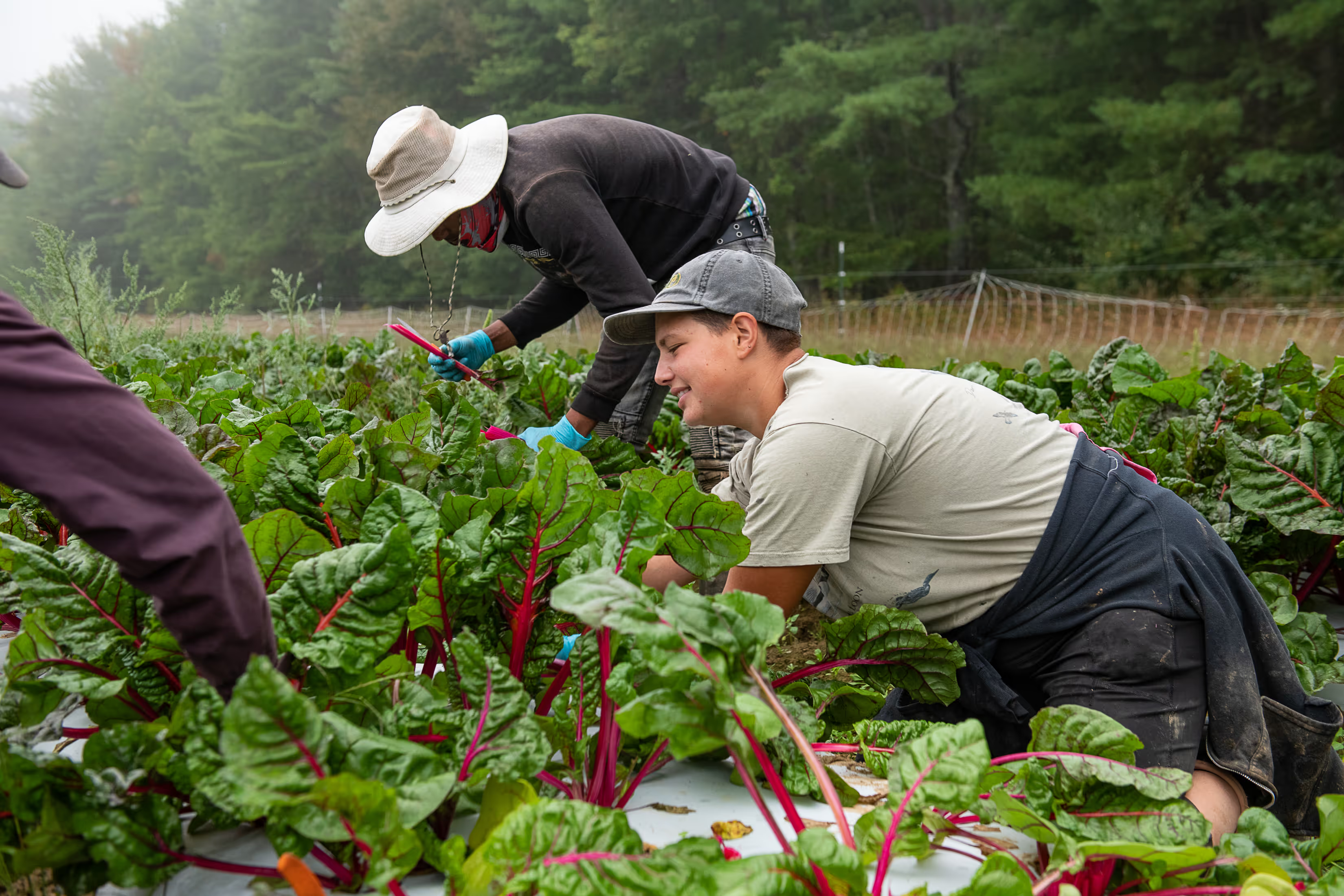
Maine farmers work hard. Reflecting back on the recently concluded Second Session of Maine’s 132nd Legislature, it is clear that the many hours that MFT staff spent at the State House pale in comparison to the tireless, never-ending work of Maine farmers to produce food, steward the land, and sustain our communities. No matter how hard a farmer works, there is so much that impacts their business that they can’t control, such as rising costs, loss of farmland, limited processing capacity, and severe weather.
At Maine Farmland Trust, we work in partnership with policymakers, partners, farmers, and supporters to influence the broader social and political environment beyond what any individual farmer can control – no matter how hard they work. By growing power for Maine farms and strengthening farm-friendly policies and programs, we can help ensure that farmers have access to the tools and resources that they need, farmland is protected and accessible, and Maine is moving towards a more robust and durable local food economy.
Our main focus this Legislative session has been securing public funding for farmland conservation and investment in farm infrastructure and processing. Other important issues we supported included removing land access barriers within Maine’s subdivision law, Wabanaki tribal sovereignty, and mental health and wellness resources for Maine’s heritage industries. The Maine Legislature adjourned on April 29th. Over the course of the session MFT:
We did this work alongside incredible Farmer Advocacy Committee members, other farmers in our network, a broad range of partner organizations, MFT supporters, and legislative champions. Thank you to all those who took action this legislative session.
Want to help grow power for Maine farms? Sign up to receive action alerts, and if you’re a farmer interested in policy change, scroll to the bottom to learn how you can share your priorities and get involved with the Farmer Advocacy Committee.
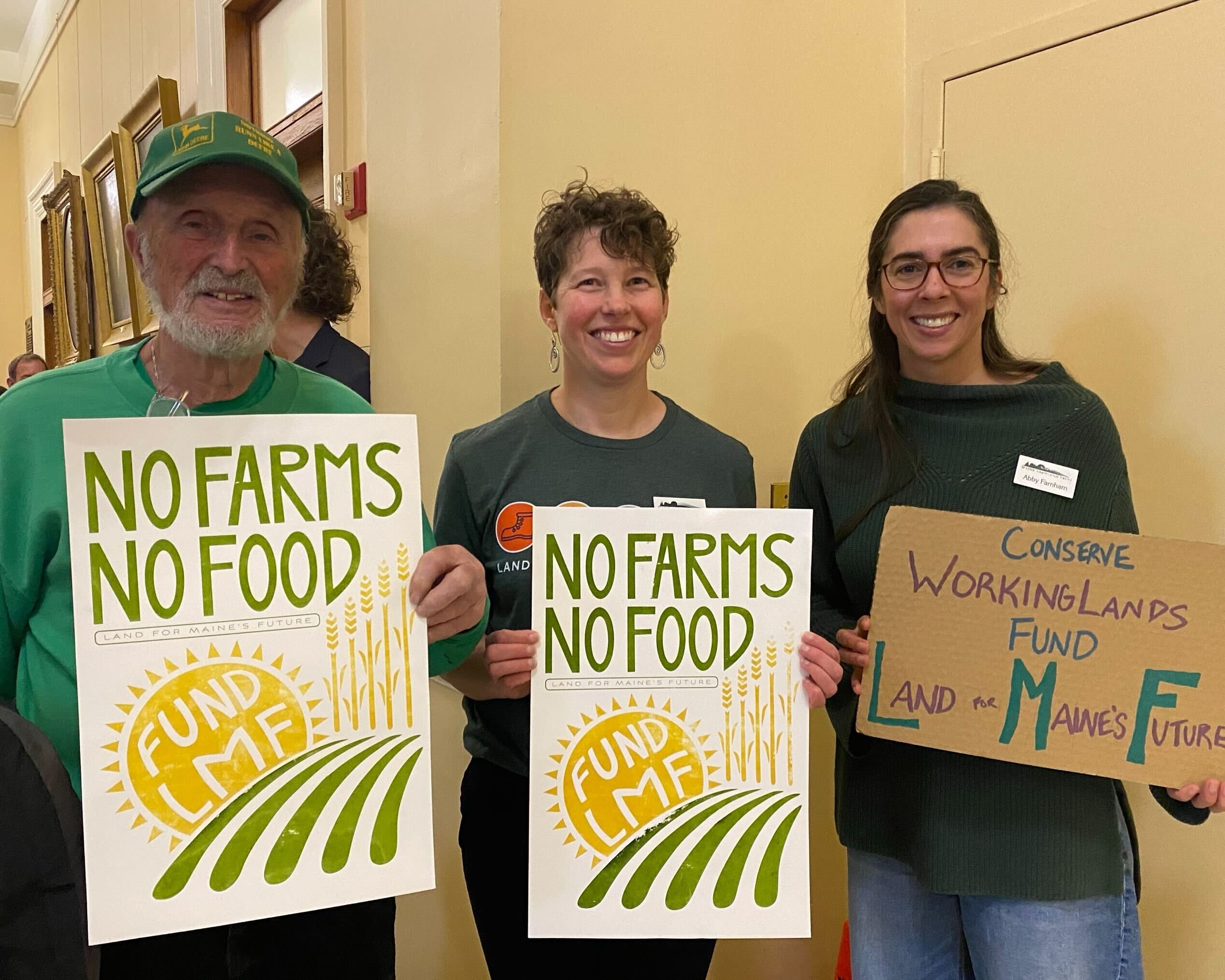
MFT joined partners in the LMF Coalition to advocate strongly for funding for the Land for Maine’s Future program this session. In what is a monumental win for LMF, the Supplemental Budget that was enacted by both chambers and signed into law on April 10, 2026 includes language that authorizes a deposit of 25% of the interest earned on the Budget Stabilization Fund to the LMF Trust Fund each month. This creative funding mechanism is expected to generate approximately $7 to $9 million in funding for LMF annually – depending on the balance of the Budget Stabilization Fund and market conditions. This investment will help to fund farmland protection projects and other efforts to conserve land for its natural and recreational value across the state.
Treating agricultural leases as divisions of land can present barriers to land access by creating unnecessary regulatory burden for farmland owners who are looking to lease their land for farming as well as confusion for municipal authorities that are interpreting subdivision law at the local level. LD 1999 was signed into law on March 9, 2026 and amended the state’s subdivision statute to make clear that agricultural leases (for example, when a landowner leases portions of farmland to multiple farmers) are not considered a division of land for the purposes of subdivision law.
A comprehensive review of state subdivision statute would help identify other needed policy changes in this area of land use law. We are excited that LD 161 was also signed into law, creating a working group of state agencies to develop recommendations for how to modernize the state’s subdivision laws to promote improved outcomes for housing, economic development, and conservation.
Through our work with farmers, we have heard how profound the need for mental health and wellness support is for members of the agricultural community and how far short existing services are falling. LD 2144 was signed into law on March 23, 2026, establishing a working group to develop recommendations for improving access to mental health and wellness care for those involved in the agriculture, fisheries, forestry and logging industries. This working group’s charge will provide the concerted effort that is needed towards better supporting the hardworking members of our state’s heritage industries.
MFT advocated alongside partners in the Wabanaki Alliance and many others across the state for two bills this session that would expand Wabanaki sovereignty, and in doing so, restore the rights and abilities of the tribes in Maine to access and steward land, regulate natural resources and land use on tribal lands, and create greater economic opportunities for the Wabanaki Nations as well as Maine’s surrounding rural communities. Both bills were significantly amended to advance changes that will benefit the Wabanaki tribes but fall far short of restoring tribal sovereignty.
LD 785 was amended to focus on expanding certain state and sales tax exemptions for Wabanaki citizens and extending an option to the Mi’kmaq Nation to have a tribal representative to the Maine Legislature, so that this option is available to all four Wabanaki Nations. LD 395 was amended to instead create a working group to develop recommendations for extending federal beneficial laws to the Wabanaki Nations. The amended versions of LD 785 and LD 395 were signed into law on April 15, 2026.
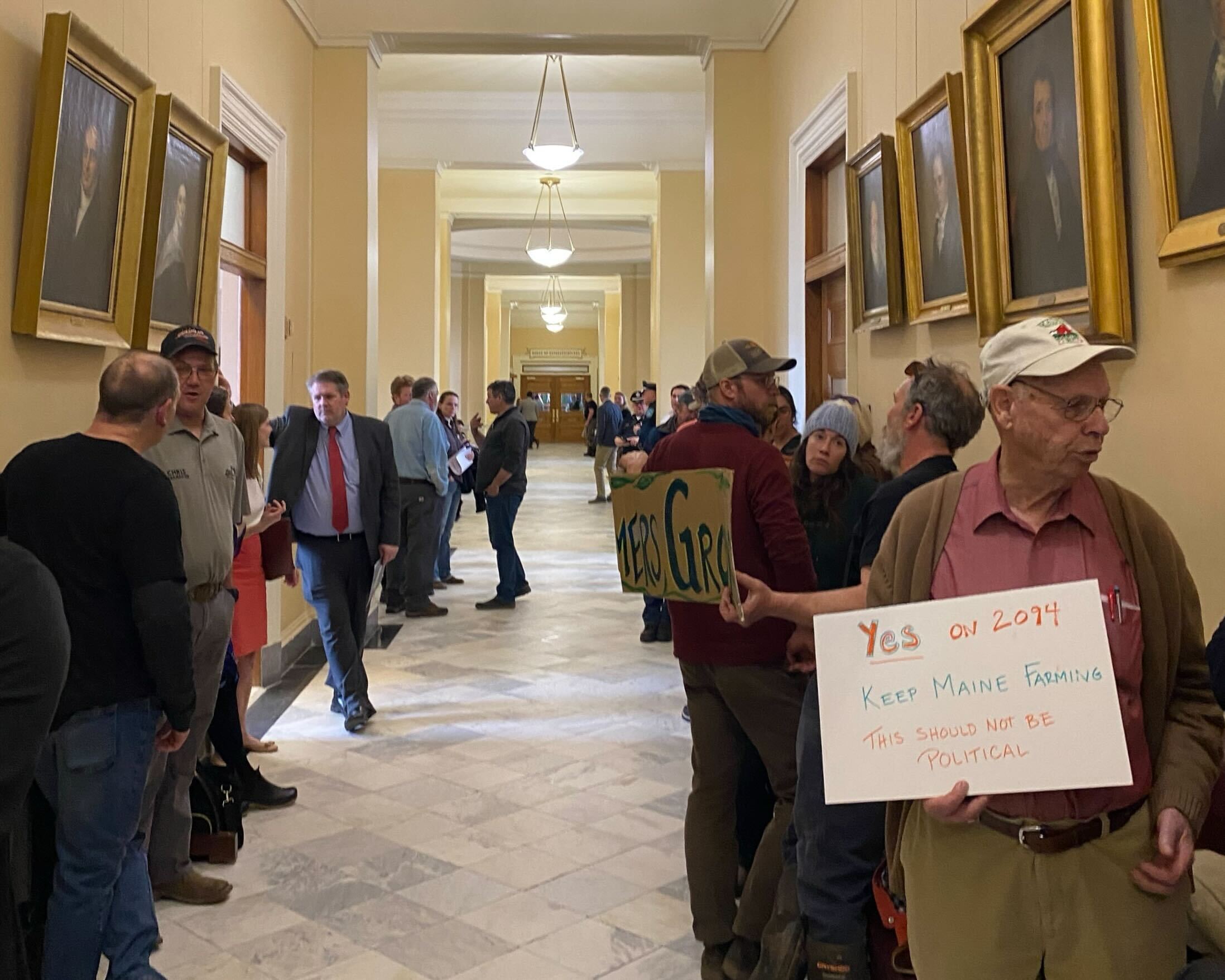
MFT worked hard alongside a broad coalition to get an Agriculture and Forestry Bond, LD 2094, passed this session, which would have provided $45 million to existing state agricultural programs related to infrastructure investment, drought relief, farmland conservation, healthy soils, and dairy sector support. The energy and engagement from farmers advocating for the bond was tremendous – farmers wrote op-eds, showed up to rallies at the State House, called their legislators, spoke with the media, and more. Farmers and their supporters added their names to a sign-on letter in support of this bond that gathered over 370 signatures. And many MFT supporters raised their voices and took action alongside us. After making exciting progress and laudable efforts from a number of lawmakers on both sides of the political aisle, the Agriculture and Forestry Bond failed to get the support needed to be enacted. The effort was 6 votes shy of the two-thirds majority needed in the House and the bond was unable to move forward. However, we built some incredible momentum together that we will carry forward to grow robust support for the future of Maine farms.
MFT also worked hard in coalition with partners and farmers on LD 2141, a bill that would have directed $2 million annually toward farmland protection through the state’s established Working Farmland Access and Protection Program and $2 million annually to a lakes restoration program housed at the Department of Environmental Protection from the estimated $10-17 million in unclaimed bottle deposits each year that mostly remain with the bottling industry. Unfortunately, opposition from the beverage industry and local industry associations blocked a path forward for this legislation.
Without the votes needed to pass legislation, an amendment was introduced and subsequently passed that reduced the scope of this effort. The amended version strengthened the State’s ability to collect annual reporting data on unclaimed deposits for beverage containers and was signed into law on April 16, 2026. While this is a significant loss, MFT hopes that this more modest change allowing for more data collection will put us in a better position to revisit this proposal in future legislatures.
The next 6+ months will bring a period of political transition, with an upcoming election that will determine Maine’s new Governor and the start of the 133rd Maine State Legislature. We will have an opportunity in the months ahead to strategize and continue to build momentum towards more public financing for farm conservation and infrastructure. You can help by sharing your ideas and speaking up for Maine farmers and farmland.
Learn how you can get involved throughout the year, and sign up to receive policy updates and action alerts. We’ll keep you in the loop on opportunities to contact your legislators and other actions you can take.
Are you a farmer interested in joining MFT to create policy change? MFT will be recruiting for a new cohort of Farmer Advocacy Committee members in the Fall of 2026. Please email our policy staff to share your interest or share your priorities as a first step towards getting involved. We’re stronger together.
Sign up for our monthly email newsletter.

%20-%20blog%20header%20(1920%20x%201080%20px)%20(1).png)